


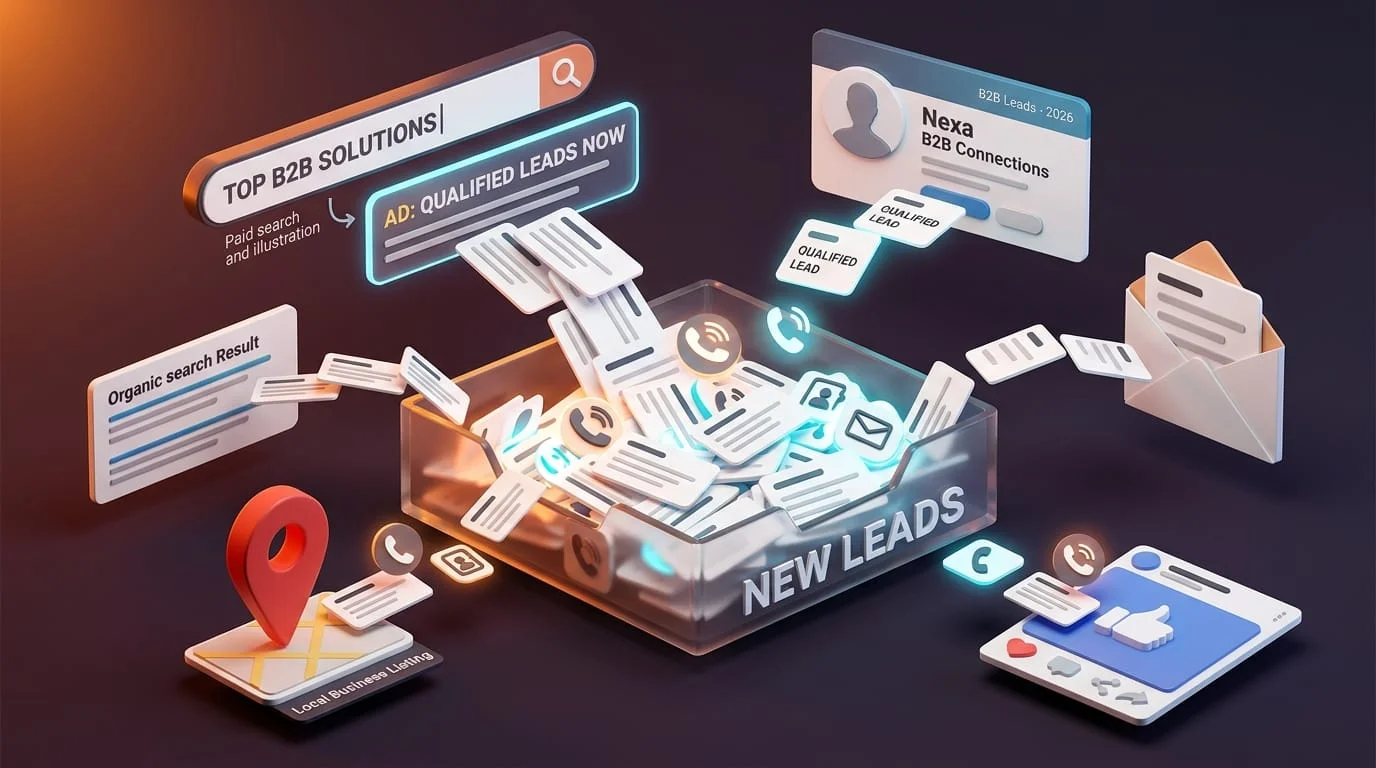
Businesses have more digital marketing channels than ever, but more options do not automatically create more customers. Search, social, SEO, Maps, email and B2B platforms can all generate leads — but they work in very different situations.
Someone actively searching for a service is in a very different position from someone casually scrolling through social media. Good lead generation starts by understanding where the customer is in the buying process.
1. Google Search & PPC: Still One of the Strongest High-Intent Channels
Paid Search remains powerful because advertisers can reach people at the moment they are actively looking for a solution.
A person searching for “accountant in Chisinau”, “roof repair near me” or “B2B lead generation agency” already has a problem and is looking for someone to solve it.
That usually makes Search particularly useful for local services, B2B companies, professional services and other businesses where customer intent can be expressed clearly in a search query.
Where Search works best
- services people actively search for;
- high-value enquiries;
- local businesses with clear geographic targeting;
- businesses with strong landing pages and accurate conversion tracking.
Google is also pushing Search advertising further toward AI-powered optimization through technologies such as AI Max, making campaign data and landing-page quality even more important in 2026.
2. SEO: Slower, but Valuable for Long-Term Demand
SEO usually does not provide the instant response of a paid campaign, but it can create a long-term source of inbound demand.
Strong service pages, useful articles and local visibility can continue attracting potential customers without paying for every individual click.
The biggest mistake is treating SEO as a traffic project rather than a lead-generation channel.
A page ranking for a commercial query is useful when visitors can quickly understand the offer and take the next step.
3. Google Maps & Local Search: Extremely Important for Local Businesses
For a business serving customers in a specific city or area, Google Maps can be much closer to the final decision than a traditional marketing channel.
Someone searching for a clinic, restaurant, showroom or local service may compare businesses, ratings, reviews, location and contact information before calling or visiting.
This makes local search particularly useful for businesses in Chisinau and other Moldovan cities where customers need a nearby provider.
Bamboo's own lead-generation approach combines Google Search, local SEO, Maps optimization and conversion-focused landing pages rather than relying on one isolated source of traffic.
4. Social Media: Better at Creating Demand Than Capturing It
Social advertising can generate leads, but the intent is usually different from Search.
People open Instagram, Facebook or other social platforms primarily to consume content, not necessarily because they are actively looking for a specific service at that moment.
That makes social particularly useful when the offer benefits from visual presentation, awareness, retargeting or an impulse-driven decision.
It can also work well when the audience is clearly defined and the campaign provides a strong reason to respond now.
Lead Quality Matters More Than Lead Volume
A campaign that generates 100 cheap form submissions is not necessarily better than one that generates 20 enquiries from people who are actually ready to buy.
In 2026, this distinction becomes even more important as advertising platforms use more AI and automation. The system needs to learn which actions represent real business value.
Businesses should therefore measure qualified calls, genuine enquiries, bookings and sales — not just clicks, impressions or every completed form.
5. LinkedIn and B2B Channels: Strong When the Buyer Is Specific
For B2B companies, the best prospect may not be searching for a supplier today.
Professional networks can help reach decision-makers by company, role or industry and create demand before an active search begins.
This can be useful for higher-value B2B services, consulting, software and other offers with a longer sales cycle.
The trade-off is that B2B leads often require more nurturing than a customer who actively searches for a service on Google.
6. Email & CRM: Often More Valuable After the First Lead
Email is sometimes discussed as a lead-generation channel, but for many businesses its strongest role comes after the first interaction.
A potential customer may request information but not be ready to buy immediately. Follow-up emails, reminders, useful content and CRM workflows can prevent those leads from simply disappearing.
This is especially important for businesses with longer decision cycles.
So Which Channels Actually Deliver Results?
There is no universal winner because different channels solve different parts of the acquisition problem.
The Strongest Lead Generation Usually Combines Channels
Businesses often make the mistake of asking one channel to do everything.
Paid Search may capture immediate demand. SEO and Maps can build ongoing visibility. Social can create awareness. Email can follow up with people who were interested but not ready to buy.
The right combination depends on the business, geography, competition, sales cycle and available budget.
Not Sure Which Channels Should Generate Leads for Your Business?
You can test every platform separately, but the fastest way to waste budget is to choose channels without understanding customer intent. Bamboo builds lead-generation systems around the channels that make sense for the business — with tracking focused on real calls, enquiries and customers.
Explore Lead GenerationFinal Thought
In 2026, the question is no longer which digital marketing channel is universally “best”.
The better question is which channel reaches your customer at the right moment — and whether your tracking can tell the difference between traffic and genuine business opportunities.
Companies that understand that difference are much more likely to build predictable lead generation instead of simply collecting more marketing activity.

 EN
EN  RU
RU  RO
RO