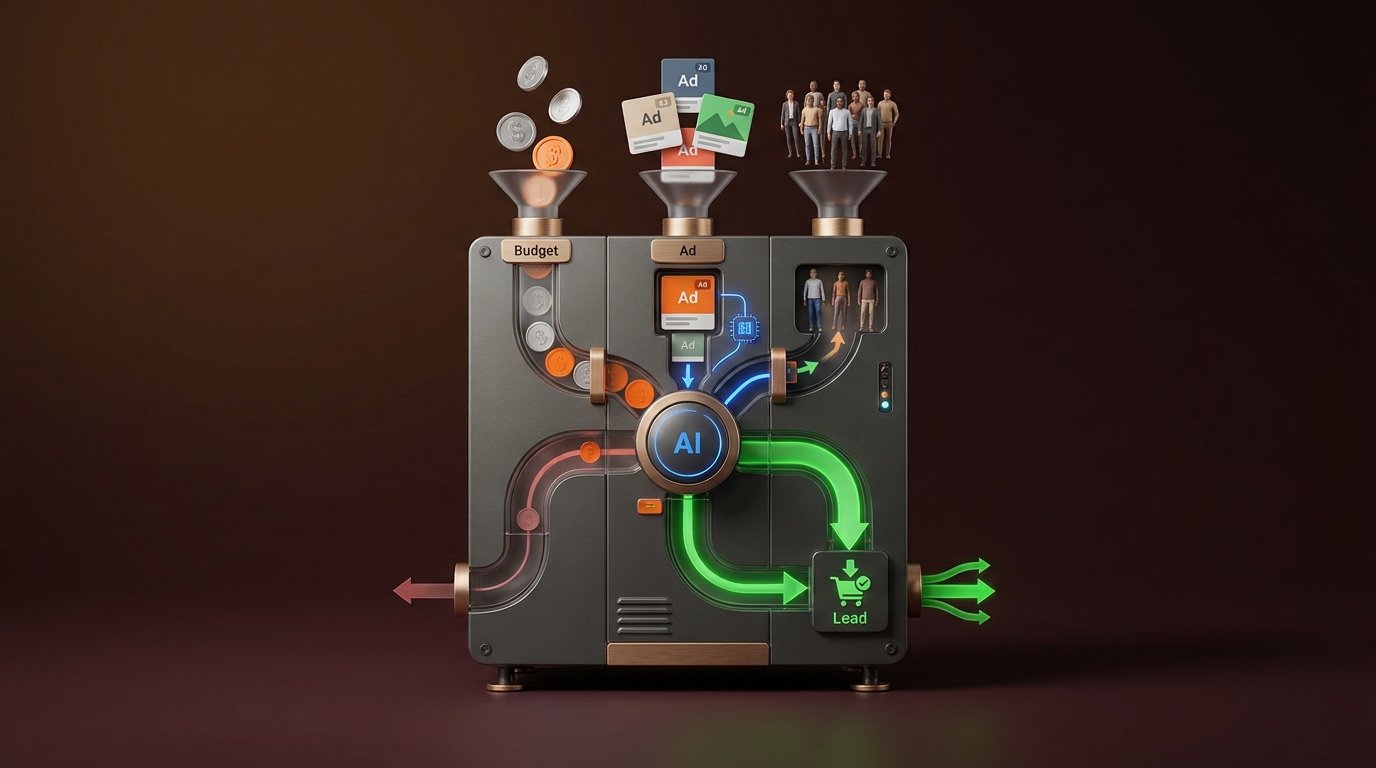
PPC management is shifting from manually controlling every keyword, audience and bid toward systems where marketers define the objective and AI makes more of the delivery decisions in real time.
PPC Management Is Becoming Less Manual
Paid advertising used to involve much more direct control over individual keywords, bids, audience segments and placements.
Those controls still exist in different forms, but the direction of major advertising platforms is clear: more decisions are being made by machine learning systems at the moment an advertising opportunity appears.
Instead of asking a marketer to predict every useful combination in advance, platforms can evaluate signals continuously and decide how an ad should be delivered.
What Is Actually Being Automated?
AI-powered advertising is not one single feature.
Automation now operates across several parts of campaign management at the same time.
Modern PPC Is Moving From Micromanagement to Machine Guidance
Automation changes the level at which advertisers work.
Instead of deciding every bid or audience combination manually, marketers increasingly provide business goals, conversion signals, creative assets, budgets and restrictions.
The advertising system then uses those inputs to make thousands of smaller delivery decisions that would be impractical to manage one by one.
Four Areas Where AI Is Taking More Control
Google Is Expanding AI Across Search and Cross-Channel Advertising
Google Ads has progressively moved automation deeper into bidding, targeting and creative delivery.
Performance Max combines advertiser-provided goals, assets and audience signals with Google's AI to optimize delivery across multiple Google advertising surfaces.
In Search, AI Max adds another optimization layer by expanding search matching, adapting text and helping connect users with relevant landing pages.
This means advertisers increasingly guide the system with objectives, business information and controls rather than manually deciding every possible query and ad combination.
Meta Is Following the Same Direction With Advantage+
Meta's Advantage+ products are designed to use AI across audience discovery, delivery, placements and campaign optimization.
Instead of building many narrow audience groups and manually deciding where every advertisement should run, advertisers can provide the system with broader goals and creative inputs.
Meta is also expanding AI-assisted creative production and testing tools, reducing the amount of manual work required to produce and evaluate advertising variations.
More Automation Does Not Mean Fewer Inputs
One of the biggest misconceptions about automated advertising is that the platform can simply be left alone.
In reality, AI becomes more dependent on the quality of the inputs it receives.
If conversion tracking rewards the wrong action, an automated system can become very efficient at finding more of the wrong result.
Better automation therefore increases the importance of accurate conversion tracking, useful customer data and a clear definition of what a valuable lead or sale actually looks like.
The Marketer's Role Is Moving Up the Funnel
When platforms handle more operational decisions, the advertiser's job becomes less about repetitive adjustments and more about defining the system correctly.
Automation Can Scale Weak Decisions Too
AI can optimize quickly, but speed does not guarantee that the underlying strategy is correct.
Poor conversion tracking, weak landing pages, low-quality offers or misleading success metrics can still damage campaign performance.
The more decisions a platform makes automatically, the more important it becomes to monitor what the system is learning from and whether the business outcome still matches the campaign objective.
Creative Variety Becomes More Important
Automated campaigns need options.
If a platform has several useful headlines, images, videos and messages, it has more combinations available when adapting delivery to different users and contexts.
But quantity alone is not the goal. Twenty nearly identical creatives give an algorithm less useful variety than several genuinely different concepts, benefits and angles.
Budget Management Is Becoming More Dynamic
Traditional PPC often required marketers to repeatedly inspect campaign performance and move money manually.
AI-driven systems can respond faster to changes in demand and predicted performance.
This can reduce routine work, but businesses still need to define overall spend limits, profitability targets and how aggressively they are willing to pursue additional volume.
The Future Is Not Fully Manual or Fully Autonomous
There is no reason every advertising decision needs the same level of human involvement.
How PPC Teams Should Adapt
The answer is not to fight automation simply because the old workflow offered more manual controls.
PPC teams need to become better at giving automated systems the right information.
That means improving conversion tracking, importing stronger business signals, producing varied creative assets, defining meaningful campaign goals and reviewing where AI is spending money.
The operational work may become simpler, while the quality of the strategic inputs becomes more important.
Better AI Advertising Starts With Better Campaign Inputs
Bamboo helps businesses connect paid advertising, conversion tracking, landing pages and lead generation around measurable customer acquisition goals — so automation works toward outcomes that actually matter to the business.
Explore PPC ServicesFinal Thought
Google and Meta are steadily reducing the number of advertising decisions that need to be made manually.
AI can evaluate audiences, bids, placements, creative combinations and performance signals at a scale that human campaign managers cannot match manually.
That does not make the PPC specialist irrelevant. It changes where their value sits: less time controlling every auction and more time deciding what the system should optimize for, what information it should receive and whether the resulting customers are actually valuable.