


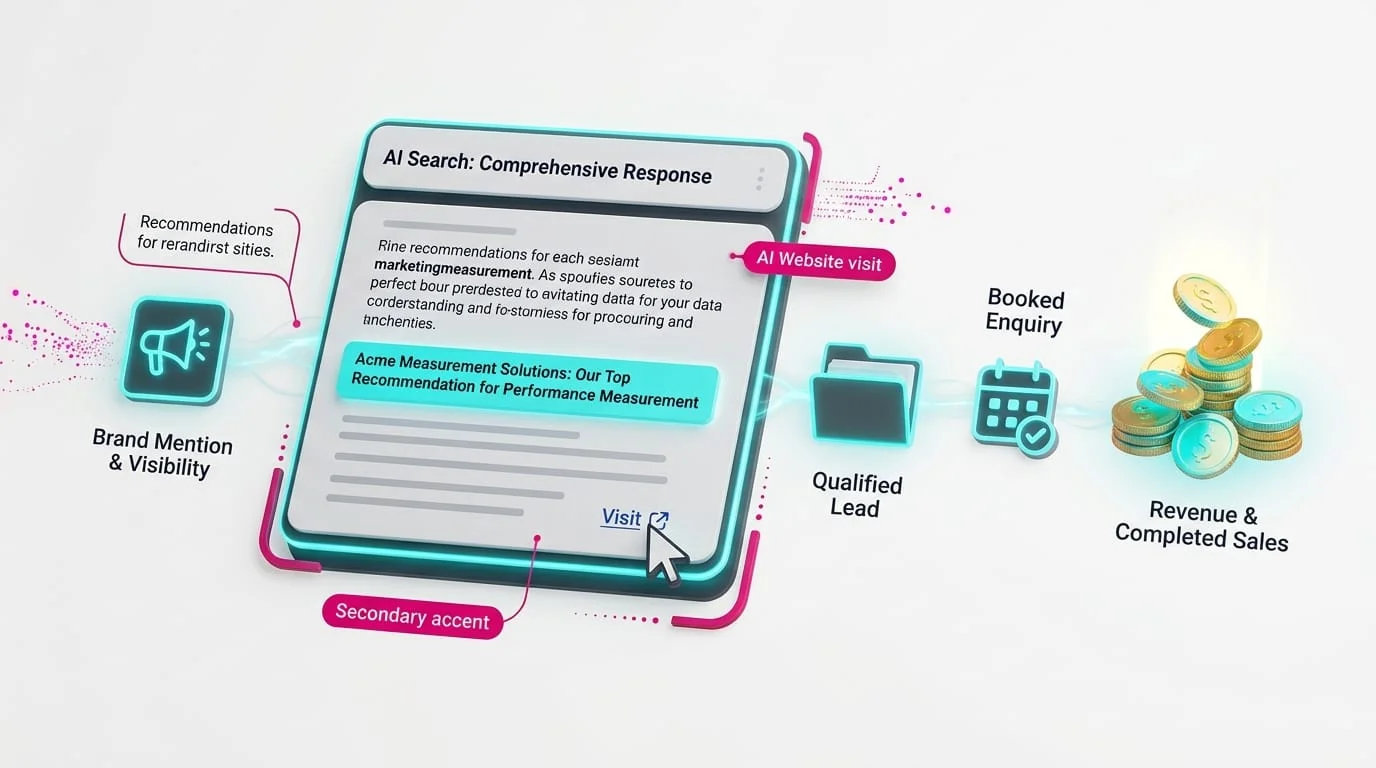
AI Search creates a measurement problem for marketers. A business may be mentioned inside an AI answer, influence a customer and build familiarity before that person ever clicks a traditional search result. Measuring ROI therefore requires looking beyond rankings and traffic alone.
AI Search ROI Starts Before the Click
Traditional search measurement has often focused on impressions, rankings, clicks and website conversions.
AI-generated answers complicate that model because users can discover a company, understand its offer and compare it with alternatives before visiting the website.
That means a brand mention inside ChatGPT, Gemini or Google's AI-powered Search can create value even when the immediate interaction does not produce a measurable click.
1. Measure Whether Your Brand Appears at All
The first layer is visibility.
Businesses should understand whether AI systems mention them for questions that actually matter commercially.
A local accounting company, for example, should care much more about being included in answers around accounting services in its market than being mentioned for a broad educational question with little buying intent.
Useful visibility measurements can include:
- how frequently the brand appears for important prompts;
- which products or services are mentioned;
- which competitors appear alongside the business;
- whether the description of the company is accurate;
- which third-party sources appear to support those answers.
2. Separate Visibility From Commercial Visibility
Not every AI mention has equal value.
Being referenced in a general informational answer may build awareness, while appearing inside a recommendation or comparison can be much closer to a purchasing decision.
That is why businesses should group prompts by intent rather than treating every AI mention as the same result.
3. Watch What Happens Around Direct Traffic
AI Search does not always send visitors through an obvious referral link.
Someone may see a company recommended, remember the brand name and later search for it directly or type the website into the browser.
This makes branded search activity and direct traffic useful supporting signals when evaluating AI visibility.
Neither metric proves that AI caused the visit, but changes can provide useful context when analyzed together with other data.
4. Track AI Referral Traffic Where It Exists
Some AI platforms do send measurable referral visits to websites.
Analytics can help identify these sessions and show what visitors do after they arrive.
Do not stop at the number of sessions. Compare engagement, important page views, enquiries and conversion quality.
Do Not Turn AI Visibility Into Another Vanity Metric
A report showing hundreds of AI mentions can look impressive while telling the business almost nothing about commercial performance.
The useful question is whether increased visibility is followed by stronger brand demand, useful website sessions, qualified enquiries and eventually revenue.
AI Search measurement becomes valuable when those signals are connected rather than reported independently.
5. Connect AI Traffic to Leads
Once a visitor reaches the website, measurement becomes much more familiar.
Track forms, phone calls, appointment requests, downloads and other meaningful actions in the same way you would for SEO or paid advertising.
The important part is identifying which of those actions represent genuine business opportunities.
Ten AI-referred sessions that create two qualified enquiries may be more valuable than hundreds of visits that create none.
6. Follow the Lead Into the Sales Process
Leads are not revenue.
To understand real ROI, businesses need feedback from CRM or sales systems.
Did the enquiry match the service? Was the lead qualified? Did the person book a consultation? Did the opportunity become a customer?
That downstream information is what turns an AI Search report into a business-performance report.
What Should an AI Search ROI Report Include?
Attribution Will Not Always Be Perfect
AI Search can influence a customer without producing a clean last-click trail.
A person may discover the brand in an AI answer, visit later through Google, return through direct traffic and finally call the company.
Trying to force every interaction into one perfectly attributed number can create false confidence.
A more realistic approach is to combine direct attribution with supporting indicators and observe whether the overall customer-acquisition picture is improving.
Do Not Measure AI Search in Isolation
AI visibility is connected to SEO, brand authority, third-party mentions, content quality, reviews and the information available about the business across the web.
That means the commercial effect may also appear across several channels.
The goal should not be to prove that every euro came directly from an AI answer. The goal is to understand whether stronger AI visibility is contributing to profitable customer acquisition.
AI Search Visibility Is Only Useful If It Supports Growth
Bamboo can help connect SEO, AI Search visibility, analytics and lead generation so that performance is measured beyond rankings and mentions — through real enquiries and customer acquisition.
Improve Lead MeasurementConcluzii
AI Search introduces new visibility metrics, but the business objective has not changed.
A mention is useful when it creates awareness. Traffic is useful when it creates opportunities. Leads are useful when they can become customers.
The strongest AI Search measurement connects all of those signals rather than treating visibility as the finish line.


 RO
RO  EN
EN  RU
RU