Google Search is becoming more conversational. Instead of reducing a need to two or three keywords, users can explain complete situations, compare options and continue asking follow-up questions inside AI Mode. Advertising is now adapting to that behaviour.
Google Search Is No Longer Limited to a Single Query
Traditional search advertising was built around relatively short moments of intent.
Someone searches for “best CRM software,” “running shoes” or “plumber near me,” and Google evaluates which organic and paid results are relevant to that query.
AI Mode introduces a different behaviour.
People can describe what they need in much more detail and continue refining that need through follow-up questions.
Google reports that AI Mode queries are, on average, around three times longer than traditional Search queries. That gives the search system more context about the problem the user is actually trying to solve.
A Search Can Now Look More Like a Conversation
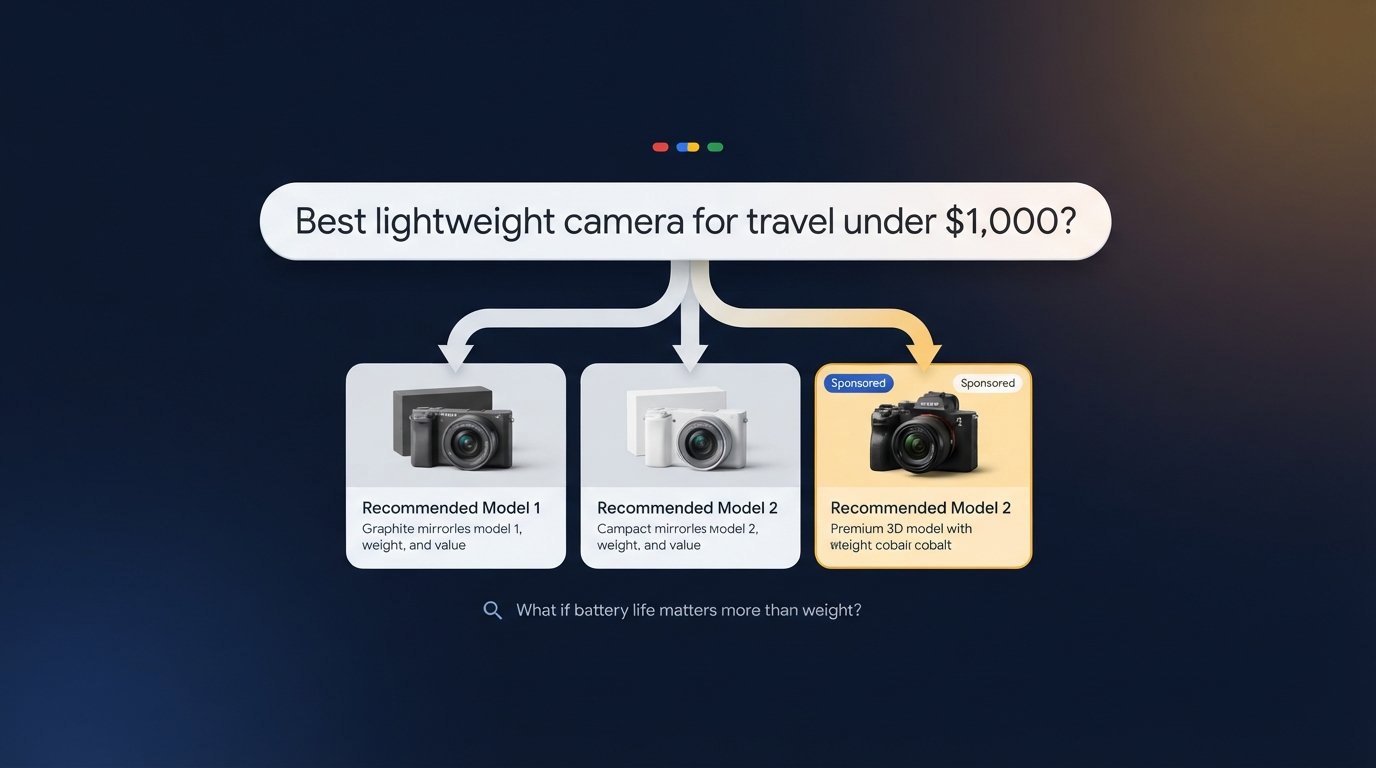
This type of interaction contains substantially more information than a traditional query such as “best travel camera.”
The user has revealed budget, priorities, intended use and trade-offs.
Those details create new possibilities for advertising because Google can evaluate whether a commercial product or service is relevant to the broader context of the conversation.
Commercial Intent Can Emerge During the Conversation
A user does not need to begin with an obvious purchase query.
Someone might initially ask how to solve a problem, understand a category or compare approaches. As Google's AI explains possible solutions, a relevant product or service can become a logical next step.
That allows advertising to appear closer to the moment when the customer understands what they actually need.
How Ads Are Matched in AI Mode
Google distinguishes between direct commercial matching and contextual matching.
That Creates Advertising Opportunities Earlier in the Journey
Traditional PPC performs particularly well when the customer already knows what category of product or service they need.
Conversational search can expose commercial opportunities before the user has reduced the problem to a product name.
Consider someone searching:
“Why does my pool keep turning green even after I clean it?”
The original question is informational. But an AI response may explain water testing, algae treatment, brushing and vacuuming.
At that point, products such as pool vacuums or treatment kits become commercially relevant even though the person never explicitly searched for one.
This is one of the most important differences between conversational search advertising and a strategy based entirely on explicit product keywords.
Brands Do Not Need a Separate “AI Mode Campaign”
One of the practical advantages for advertisers is that AI Mode does not require an entirely separate Google Ads account structure.
Existing eligible Search, Shopping and Performance Max campaigns can participate in advertising auctions across Google's AI-powered Search experiences when the campaign and query are relevant.
Advertisers therefore do not need to create a special budget simply to become eligible for AI Mode.
The more important question is whether the existing campaign gives Google's systems enough useful information to understand where the business belongs.
AI-Powered Targeting Becomes More Important
Not every Search targeting method participates in contextual matching in the same way.
Google says AI-powered approaches including AI Max for Search, broad match, Shopping campaigns and Performance Max can participate in both direct and contextual matching.
Exact and phrase match keywords remain useful when a user's query directly expresses commercial intent, but they are not used for broader contextual matching in exploratory AI conversations.
That matters because many new commercial opportunities in AI Mode may emerge from questions that do not contain the advertiser's traditional keyword at all.
Google Is Creating New Ad Formats Specifically for AI Search
AI Explainers Introduce a New Layer Between the Brand and the Customer
Some AI Search ad formats include an independent explanation generated by Google's Gemini models.
The explainer can help the user understand why an advertised product or service is relevant to the current question.
This is different from normal ad copy.
Google states that these explanations are generated independently using context from the query, the AI response and publicly available information, including information from the advertiser's website. Advertisers cannot manually write or edit the explainer.
That introduces an important new requirement for brands.
The information Google can understand about the business needs to be accurate, clear and consistent.
Weak product descriptions, confusing landing pages or incomplete website information become more important when AI systems are helping explain why a business may be relevant.
Advertisers Need to Think Beyond Ad Copy
Traditional PPC optimization often focuses heavily on keywords, bids and the wording of the advertisement.
Those elements still matter, but AI Mode creates a wider information environment.
Product feeds, landing pages, website content, conversion tracking and business information can all contribute to Google's ability to understand the advertiser and determine when an offer is relevant.
Five Things Brands Should Prepare Now
Longer Queries Could Reveal Stronger Commercial Intent
More words do not automatically mean a user is closer to purchasing.
But a longer conversation can expose details that marketers previously had to infer.
Budget, use case, location, preferences, limitations and previous alternatives can all appear naturally during the search process.
That allows the advertising system to evaluate relevance using much more than a single phrase.
Multi-Turn Search Changes When an Ad Can Appear
The first query may not be the most commercially valuable part of the conversation.
A person might begin broadly, learn something from the AI response and then narrow the problem over several follow-up questions.
In October 2026, Google announced multi-turn ads in AI Mode in the United States, allowing advertising to participate in follow-up queries as the conversation develops.
For advertisers, this creates the possibility of entering the journey later — when the user's requirements are clearer and a specific commercial solution has become more relevant.
AI Mode Advertising Is Already Expanding Internationally
Ads in AI Mode began as a limited experience, but Google is expanding them to additional markets.
In October 2026, Google announced expansion into countries including Australia, Canada, India, Kenya, Malaysia, New Zealand, Nigeria, Pakistan, the Philippines and Singapore.
Google continues to test additional countries, languages and formats, so availability is still evolving.
Businesses should therefore check current Google Ads eligibility rather than assuming every AI Mode advertising format is available in every market.
Google states that buying advertising does not influence the organic answer produced by AI Mode or AI Overviews. A brand can appear organically, through a sponsored placement, through both mechanisms at different moments, or not appear at all.
AI Mode Does Not Eliminate Traditional Search Ads
Many searches are still simple.
Someone looking for “emergency plumber Chisinau” may not need a long AI conversation before taking action.
Traditional Search ads remain useful for direct, high-intent queries where the user already understands what they need.
AI Mode expands the range of searches where commercial relevance can emerge.
The two experiences are therefore more likely to coexist than to replace one another completely.
What Should Brands Measure?
AI Mode Changes the PPC Skill Set
Search advertising is gradually moving away from a workflow where success depends primarily on manually predicting every keyword variation.
Advertisers still need campaign controls, exclusions and commercial judgment, but the strategic value increasingly shifts toward giving Google's systems accurate information and meaningful objectives.
That means better measurement, stronger website content, useful product data, clear offers and a deeper understanding of the questions customers ask before purchasing.
Your PPC Strategy Needs to Work Across Both Keywords and Conversations
Bamboo helps businesses build and optimize PPC campaigns around measurable customer acquisition — from traditional Search advertising to the new AI-powered experiences changing how people discover and evaluate brands.
Узнать больше о контекстной рекламе (PPC)Заключение
Google AI Mode changes advertising because it changes the search journey itself.
Instead of presenting one short query, users can explain a problem, compare alternatives and refine their requirements through a conversation.
Advertising can now become relevant at several points inside that process — including moments where commercial intent was not obvious in the original question.
For brands, the opportunity is larger than simply gaining another Search ad placement.
The real opportunity is becoming the most relevant commercial answer when a customer has finally explained exactly what they need.