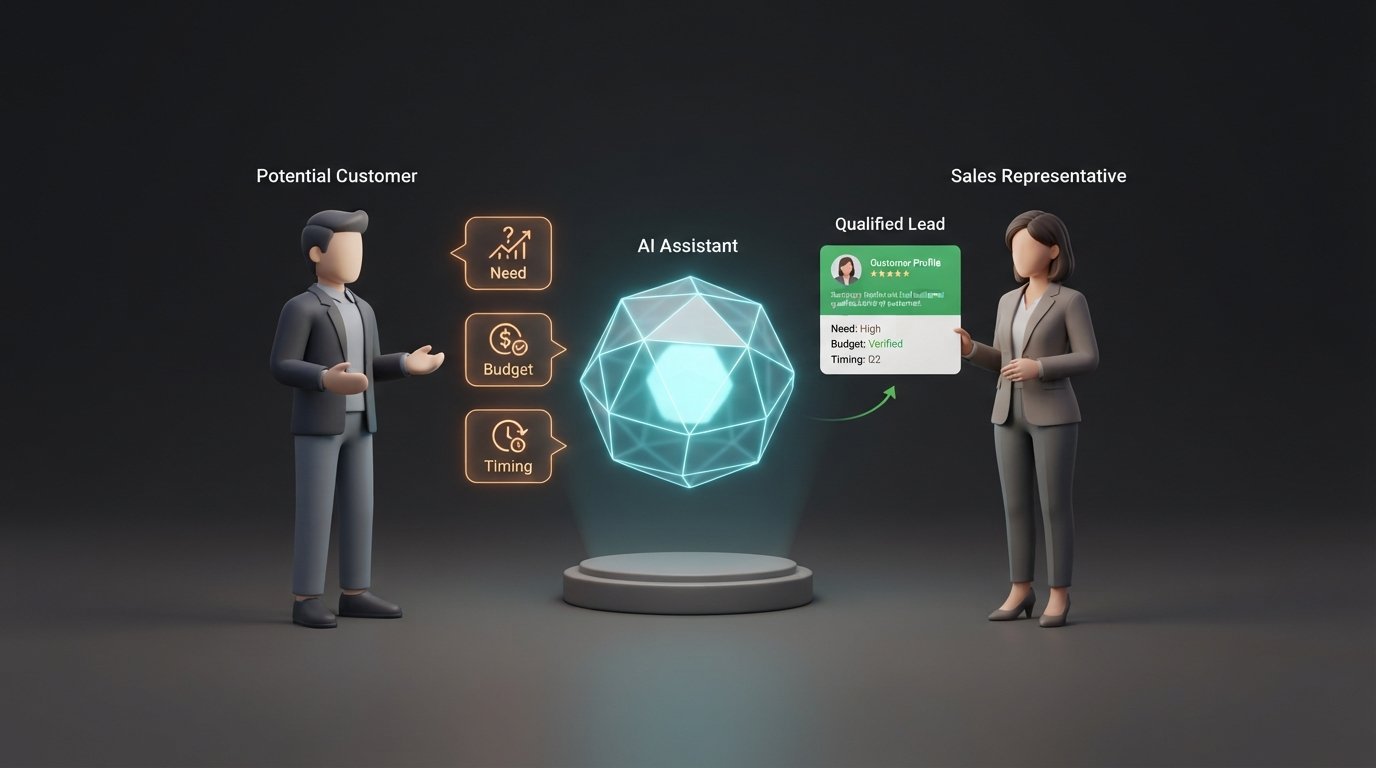
AI customer service agents are moving beyond answering simple support questions. They can now engage potential customers, collect qualification information, update CRM records and pass stronger opportunities to sales teams with the context already attached.
Lead Qualification Has Always Been a Capacity Problem
Marketing can generate hundreds or thousands of enquiries, but not every person who fills out a form is ready to buy.
Sales teams therefore spend significant time determining who has a real need, whether there is sufficient budget, how urgent the project is and who is actually involved in the decision.
When lead volume grows faster than the team, response times increase and promising prospects can disappear before anyone has properly spoken with them.
AI Customer Service Agents Are Becoming More Than Chatbots
Traditional chatbots usually follow predefined menus or simple rules.
Modern AI agents can work with business knowledge, customer data, CRM systems and predefined qualification rules to conduct a more natural conversation.
They can answer questions while also gathering the information the business needs to decide whether the prospect should continue to a salesperson.
That distinction is important. The goal is not simply to create a chatbot that talks more naturally. The goal is to connect conversation with a business workflow.
The AI Agent Can Handle the Conversation Before Sales Needs to Join
Instead of sending every enquiry directly to a salesperson, businesses can place an AI agent between initial interest and the sales conversation.
The agent can answer routine questions, understand what the prospect wants, collect qualification information and apply predefined business rules.
Human salespeople can then focus their time on opportunities that are ready for a more valuable conversation.
What Can an AI Agent Ask?
The exact qualification criteria depend on the business.
A B2B company may care about budget, authority, need and timeline. A service business may need location, project type and urgency. A property company might ask about budget range, preferred area and expected purchase date.
Real Businesses Are Already Using This Model
AI-based qualification is no longer only a theoretical sales concept.
Siemens has deployed separate AI agents for engagement and qualification of inbound leads. One agent handles initial outreach and follow-up, while another gathers qualification information and determines whether the lead should be routed to a salesperson.
The qualification process uses business-defined rules rather than allowing the AI to make completely unrestricted decisions.
That combination is important: conversational flexibility on the customer side, controlled logic on the business side.
For lead qualification, predictable rules, reliable data and clear escalation boundaries can matter more than allowing the system to make every decision independently.
Why Immediate Response Matters
A prospect who has just requested information is usually more engaged than the same prospect several hours later.
An AI agent can respond immediately, including outside normal working hours, without forcing the company to keep a large qualification team available at every moment.
This is particularly useful for businesses receiving enquiries across countries, languages or time zones.
The AI Can Continue the Conversation Instead of Just Collecting a Form
Traditional lead forms capture structured information, but they cannot respond when the customer has a question.
A conversational agent can collect similar information while simultaneously explaining the service, clarifying requirements and adjusting its next question based on the previous answer.
That can make qualification feel more like a useful conversation and less like an interrogation.
What Should AI Handle — and What Should Sales Handle?
The Handoff Is More Important Than the Chat
A good AI conversation has limited value if the information disappears when a human joins.
The sales representative should not have to restart the qualification process by asking the customer everything again.
Can AI Replace Traditional Lead Qualification?
It can replace a significant part of the repetitive first layer.
Businesses do not necessarily need a human to ask the same initial questions hundreds of times if those questions are structured and the qualification criteria are clear.
But qualification is not always purely mechanical.
A prospect may describe an unusual situation, hide uncertainty behind a simple question or require commercial judgment that is difficult to reduce to a predefined rule.
For that reason, the more realistic model is usually not AI replacing sales, but AI changing when sales becomes involved.
The business should define the criteria, approved information, escalation rules and situations where a human must take over. Otherwise automation can consistently make the wrong decision at scale.
Bad Data Creates Bad Qualification
An AI agent needs reliable information about the business.
If pricing, service areas, product availability or qualification rules are outdated, the agent can confidently give incorrect answers.
The same applies to CRM data. Duplicate records, missing fields and unclear lead definitions reduce the value of automated qualification.
AI can make a process faster, but it cannot automatically make an unclear process strategically correct.
Lead Scoring Alone Is Not the Same as Qualification
Traditional scoring systems often assign points based on actions: opening an email, visiting a pricing page or downloading a document.
Those signals can be useful, but they do not always explain the customer's situation.
Conversational qualification adds another layer because the prospect can directly describe the need, urgency and constraints.
The strongest systems can combine both: behavioural signals plus information gathered during the conversation.
AI Agents Can Work Across More Than Website Chat
Qualification does not have to begin only in a website widget.
AI agents can increasingly work across email, messaging and voice channels, depending on the platform and integration.
The principle remains the same: maintain the conversation context, use approved business information and transfer the opportunity to a human when the predefined threshold is reached.
What Businesses Should Measure
The goal should not be to maximize the number of conversations handled by AI.
The goal is to improve the quality and efficiency of the pipeline.
- Response time to new enquiries.
- Percentage of leads successfully engaged.
- Qualification rate.
- Meeting or appointment booking rate.
- Sales acceptance rate of AI-qualified leads.
- Conversion from qualified lead to customer.
- Frequency of incorrect qualification or unnecessary escalation.
The Best Model Is Usually AI First, Human at the Right Moment
AI is particularly strong when the business needs speed, consistency and capacity.
Humans are particularly valuable when the conversation requires judgment, trust, negotiation or an understanding of unusual context.
Combining those strengths changes the lead qualification process from “everyone talks to sales” into “sales joins when its involvement creates the most value.”
Lead Generation Works Better When the Right Leads Reach Sales Faster
Bamboo helps businesses connect lead generation, advertising and conversion processes around measurable customer acquisition — from creating demand to delivering stronger opportunities to the sales team.
Подробнее о лидогенерацииЗаключение
AI customer service agents are beginning to remove one of the most repetitive parts of the sales process: the first qualification conversation.
They can respond immediately, ask structured questions, capture context and decide when a prospect should move forward.
But the strongest implementation does not try to eliminate people from the process completely.
It uses AI to make sure that when a salesperson finally enters the conversation, the customer is relevant, the context is already known and both sides can spend their time on the part of the sales process that actually requires human judgment.