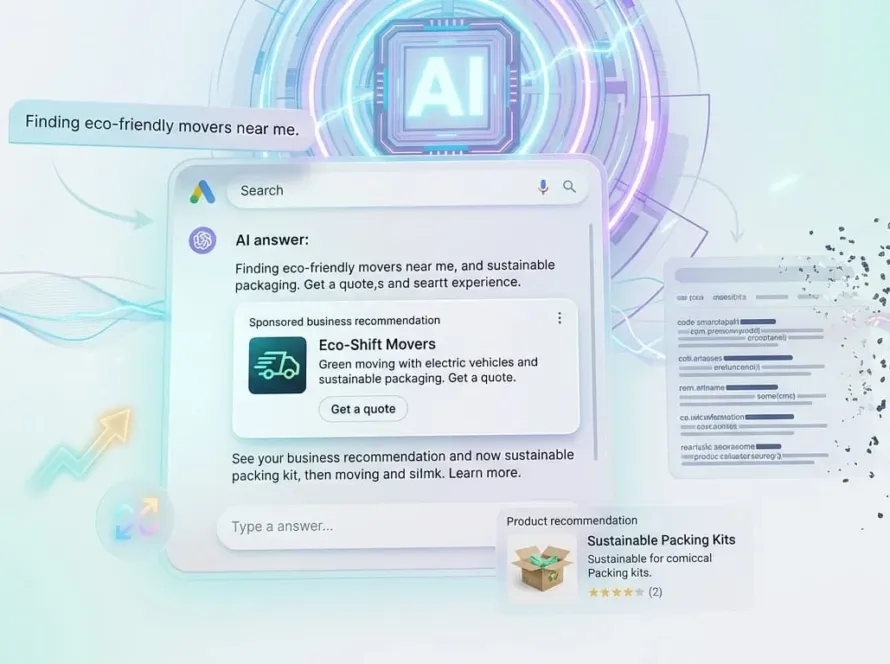
Digital advertising is moving beyond AI that simply writes copy or suggests optimizations. Agentic AI can increasingly analyze campaign context, work across connected tools and help carry advertising tasks from insight to action with much less manual coordination.
What Makes Agentic AI Different?
Most marketers already use AI for individual tasks. It can create ad copy, summarize reports, generate campaign ideas or explain why a metric changed.
Agentic AI goes further by connecting several of those tasks together.
Instead of only answering a question, an agent can work toward a broader objective, inspect relevant information, decide what it needs to do next and use connected systems to continue the process.
From Manual Campaign Management to Agentic Workflows
Advertising Is Moving Toward Continuous AI Decision Loops
Traditional automation usually follows predefined rules. Agentic systems can work with a broader objective and decide which available action is most useful based on current context.
That creates the possibility of advertising workflows that continuously monitor performance, investigate changes, recommend adjustments and prepare the next campaign action without requiring a marketer to restart the process manually every time.
What Can AI Agents Actually Do in Advertising?
Google Ads Is Already Becoming More Agentic
Google has been expanding agentic capabilities across its advertising and analytics products.
Ask Advisor is designed to work across Google Ads, Google Analytics, Merchant Center and other marketing products. A marketer can describe a goal, while the system uses information from the connected environment to help move from the objective toward campaign setup, analysis and the next action.
Google also describes its agentic advertising tools as a way to connect performance insight with execution while keeping the marketer in control. :chatgpt-content-reference{index="1"}
An agent that understands the campaign objective, previous actions and current performance can make more useful decisions than a tool receiving each request as an isolated prompt.
Audience Analysis Becomes Faster and More Dynamic
Audience analysis has traditionally required marketers to work through multiple reports and predefined segments.
Agentic AI can help interpret much larger amounts of information at once, identify relevant patterns and compare those patterns with the campaign objective.
That does not mean the agent magically knows who the best customer is. Its conclusions still depend on the quality of the available data and the objective the business provides.
Campaign Optimization Can Become More Continuous
Traditional campaign optimization often happens in cycles: the marketer checks performance, identifies a problem, makes a change and returns later to see what happened.
Agents can reduce the delay between those stages.
A system can monitor performance, detect a meaningful change, investigate the likely cause and prepare the next action while the campaign is still running.
Where Agentic AI Creates the Most Value
Autonomy Does Not Mean Unlimited Control
Giving an AI agent access to advertising tools introduces an important question: what should it actually be allowed to change?
Generating a report carries very little risk. Doubling a campaign budget, changing a major offer or publishing customer-facing claims can have much larger consequences.
The business should define which actions can happen automatically, which require approval and which decisions remain completely human-owned.
The Right Level of Autonomy Depends on the Decision
Better Agents Still Need Better Data
Autonomous optimization does not remove the importance of measurement.
If conversion tracking is wrong or the business optimizes toward poor leads, the agent may simply become faster at optimizing toward the wrong outcome.
Clean conversion data, useful CRM feedback and a clear definition of a valuable customer become even more important when more decisions are automated.
Will AI Agents Replace Advertising Specialists?
Agentic AI is more likely to change the type of work marketers spend their time doing.
Less time may be required for repetitive reporting, routine campaign investigation and moving information manually between platforms.
More value shifts toward defining business objectives, reviewing decisions, developing offers, understanding customers and deciding where automation should stop.
OpenAI's own advertising tools are also moving in this direction: its 2026 advertising updates describe campaign creation, updates and performance analysis through natural-language workflows, while keeping advertiser review and control in the process. :chatgpt-content-reference{index="2"}
Agentic Advertising Is Still an Operating System, Not a Strategy
An AI agent can help execute a strong strategy faster.
It cannot compensate for a weak offer, poor conversion tracking, unclear positioning or a business that has not decided which customers it actually wants.
The strongest agentic workflows therefore start with good marketing fundamentals and automate the work around them.
AI Agents Become More Valuable When the Marketing System Is Built Around Clear Goals
Bamboo helps businesses connect advertising, analytics, lead generation and digital strategy so that AI automation can work around real customer acquisition goals rather than isolated marketing tasks.
Explore Digital Marketing ServicesFinal Thought
Agentic AI represents a bigger change than simply generating faster advertising content.
It introduces systems that can observe what is happening, reason about the next step and increasingly help execute that decision across the campaign workflow.
The advantage will not come from giving AI unlimited control. It will come from combining faster autonomous execution with clear objectives, reliable data and sensible human oversight.