


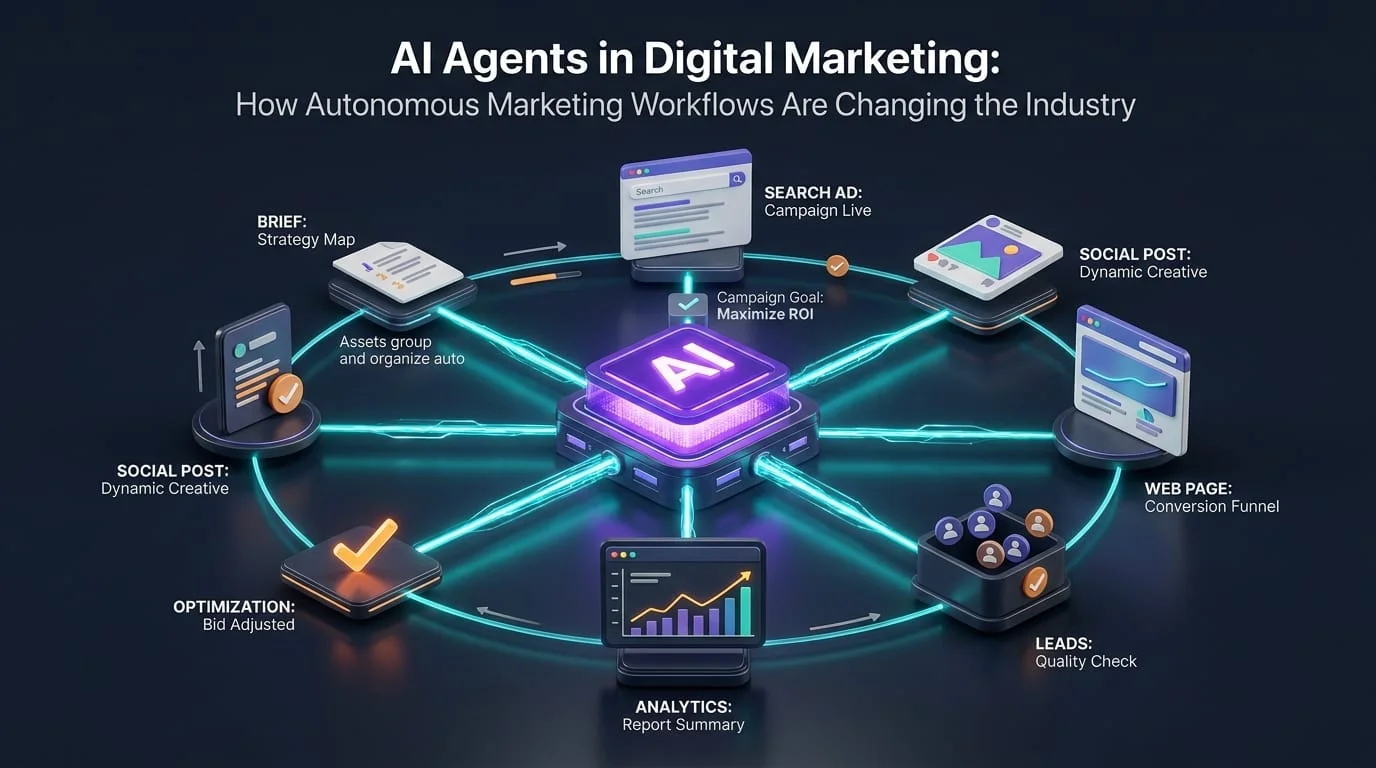
Digital marketing automation is moving beyond tools that simply answer questions or generate content. AI agents are beginning to receive goals, use multiple systems, analyze results and complete sequences of work with much less manual input.
What Is an AI Agent in Marketing?
A normal AI assistant usually responds to a request. You ask for an ad headline, a report summary or an idea, and it produces an answer.
An AI agent can work more like an operator.
It can receive an objective, gather relevant information, choose the next action, use connected tools and continue working until part of that objective has been completed.
Marketing Platforms Are Already Moving in This Direction
In 2026, agentic marketing is no longer only a concept demonstrated in AI labs.
Google is introducing agentic experiences across Ads and Analytics. Its Ask Advisor system is designed to work across Google Ads, Google Analytics, Merchant Center and other marketing products rather than treating each platform as an isolated tool.
A marketer can describe a business objective, while the agent can use information from multiple Google products to help create campaigns, investigate performance or recommend what should happen next.
Where Autonomous Workflows Can Save Time
The clearest opportunities appear where marketers currently move information manually between tools.
Campaign preparation
An agent can potentially gather product information, inspect previous campaign data, help prepare creative direction and turn the result into a new campaign setup.
Performance investigation
Instead of opening several reports separately, an agent can combine context from advertising and analytics data, identify a performance change and help investigate possible causes.
Creative operations
Agentic workflows can coordinate research, briefs, first drafts, variations and review preparation instead of requiring someone to restart the context at every stage.
Lead handling
Incoming enquiries can be categorized, summarized and routed before the sales team begins its own work.
Marketing Automation Is Moving From Tasks to Outcomes
Traditional automation is usually based on rules: when this happens, do that.
Agentic systems can work with a broader goal, interpret context and choose between several possible actions. That makes them more flexible — but also increases the importance of permissions, reliable data and human oversight.
The more autonomy a system receives, the more clearly the business needs to define what the agent is allowed to change.
From Separate Tools to Continuous Workflows
The traditional marketing stack often forces people to become the connection between every platform.
Someone exports campaign results, checks Analytics, opens a spreadsheet, writes a summary, sends it to another person and then manually updates the next campaign.
Agents can reduce some of that hand-off work by carrying context between steps.
Why Data Quality Becomes Even More Important
An autonomous workflow can execute faster than a human team, which also means poor inputs can create poor decisions faster.
If conversion tracking is wrong, customer information is incomplete or campaign goals are unclear, an agent may make perfectly logical decisions based on the wrong definition of success.
Better automation therefore increases the value of clean measurement, useful CRM data and clear business rules.
AI Agents Still Need Boundaries
Autonomy should not mean unlimited access.
A useful marketing agent needs to know which actions it can perform independently, which actions require approval and which decisions should remain entirely human-led.
Drafting a campaign report is very different from doubling an advertising budget. Categorizing a lead is very different from making a contractual promise to a customer.
Will AI Agents Replace Digital Marketers?
More likely, they will change which parts of marketing require the most human time.
Less time may be spent copying data, preparing repetitive reports and moving instructions between platforms.
More value shifts toward defining goals, reviewing outputs, understanding customers, creating differentiated offers and deciding what should happen next.
That is a significant industry change even without removing the marketer from the process.
AI Agents Work Best When the Marketing Foundation Is Already Clear
Autonomous workflows cannot fix unclear offers, weak tracking or a disconnected customer journey. Bamboo helps businesses build the digital marketing structure first — so automation, advertising, SEO and lead generation can work around real business goals.
Explore Digital Marketing ServicesThe Industry Is Moving Toward Agentic Marketing
Marketing AI is progressing from content generation toward systems that can analyze, decide and act across connected tools.
The businesses that benefit most will not necessarily be those that give AI the most autonomy.
They will be the ones that know which work should be automated, which decisions require approval and which outcomes actually matter to the business.


 EN
EN  RU
RU  RO
RO